
Georgia Tech Researchers Share AI Cyber Challenge Lessons at USENIX Security 2026
What can artificial intelligence (AI) do to protect software from cyberattacks?
Georgia Tech researchers spent two years helping to answer that question through DARPA’s AI Cyber Challenge (AIxCC), a competition designed to test whether AI could identify and fix security vulnerabilities in real-world software.
Now, they are sharing what they learned with the cybersecurity community.
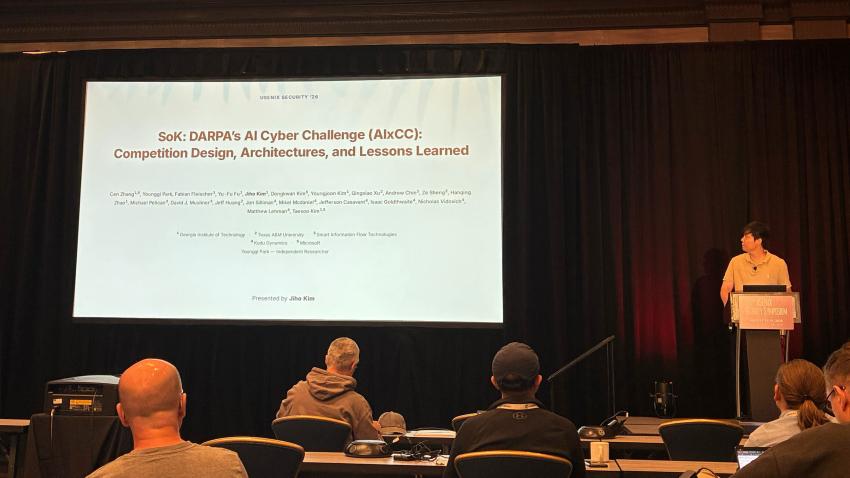
Their paper, SoK: DARPA’s AI Cyber Challenge (AIxCC): Competition Design, Architectures, and Lessons Learned, was presented at USENIX Security 2026, one of the world's leading cybersecurity conferences. The paper was selected as a runner-up for the conference’s distinguished paper award, placing it among 36 recognized papers from 362 accepted papers out of 3,028 submissions.
The paper examines how the seven finalist teams approached the competition and what the results reveal about the future of AI-powered cybersecurity.
Georgia Tech researchers spent two years helping to answer that question through DARPA’s AI Cyber Challenge (AIxCC), a competition designed to test whether AI could identify and fix security vulnerabilities in real-world software.
Now, they are sharing what they learned with the cybersecurity community.
Their paper, SoK: DARPA’s AI Cyber Challenge (AIxCC): Competition Design, Architectures, and Lessons Learned, was presented at USENIX Security 2026, one of the world's leading cybersecurity conferences. The paper was selected as a runner-up for the conference’s distinguished paper award, placing it among 36 recognized papers from 362 accepted papers out of 3,028 submissions.
The paper examines how the seven finalist teams approached the competition and what the results reveal about the future of AI-powered cybersecurity.
Recent Stories

Veronica Rivera in…
Tuesday, October 20, 2026

Where Are They Now? Team Atlanta…
Tuesday, October 20, 2026

When a Ship’s Systems Lie, Cybersecurity Gets…
Monday, October 19, 2026